Have you ever wondered what exactly a mole is in science? You might have heard the term in chemistry class or seen it in textbooks, but what does it really mean?
Understanding the mole is key to unlocking many concepts in chemistry, and it can make your studies much easier. You’ll discover which statement best describes a mole and why it matters to you. Keep reading to clear up the confusion and boost your knowledge with simple explanations you can trust.
Credit: www.chegg.com
Basic Concept Of A Mole
The mole is a key idea in chemistry. It helps us count tiny particles like atoms and molecules. Counting these particles directly is impossible because they are too small. The mole gives a way to group them in large numbers.
One mole equals a very big number of particles. This number is called Avogadro’s number. It is about 6.022 x 10²³. Using the mole, chemists can talk about amounts of substances easily. It connects the microscopic world to what we can measure.
Definition Of A Mole
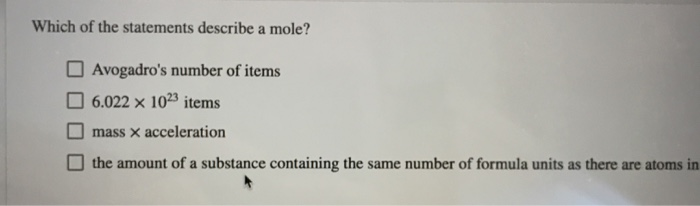
A mole is the amount of substance that contains exactly 6.022 x 10²³ particles. These particles can be atoms, molecules, ions, or electrons. The mole is a standard unit in chemistry. It helps compare different substances by the number of particles.
Avogadro’s Number Explained
Avogadro’s number is 6.022 x 10²³. It is the number of particles in one mole. This number is huge because atoms and molecules are very tiny. It allows us to count particles by weighing substances. This makes chemistry calculations possible.
Importance Of The Mole In Chemistry
The mole links the mass of a substance to the number of particles. It makes measuring chemical reactions easier. Scientists use moles to balance equations and find amounts needed. The mole also helps in calculating concentrations and volumes.
Credit: www.chegg.com
Historical Origins Of The Mole
The mole is a key concept in chemistry. It helps count tiny particles like atoms and molecules. The idea started a long time ago. Scientists needed a way to measure very small things in large groups.
The mole allows chemists to use a simple number for large quantities. It connects the weight of a substance to the number of particles it contains. This made chemistry easier to understand and use.
The Early Ideas Behind The Mole
In the 19th century, scientists worked on atomic theory. They guessed that matter was made of atoms. Counting atoms was difficult because they are very small. They used the idea of a “gram-molecule” to describe amounts of substances.
This idea evolved over time. Scientists tried to find a standard number for these particles. They wanted a number that could link the atomic scale to real-world measurements.
Avogadro’s Contribution
Amedeo Avogadro proposed a key idea in 1811. He said equal volumes of gases have the same number of particles. This was important for understanding the mole. It gave a way to compare different gases by counting particles.
Avogadro’s work led to the idea of a fixed number of particles in a mole. This number is now called Avogadro’s number. It is about 6.022 x 10²³ particles per mole.
The Formal Definition Of The Mole
The mole became an official unit in the 20th century. The International System of Units adopted it in 1971. The mole is defined by the number of atoms in 12 grams of carbon-12.
This definition links the mole to a physical standard. It helps scientists measure substances accurately. The mole remains vital in chemistry and science education.
Avogadro’s Number Explained
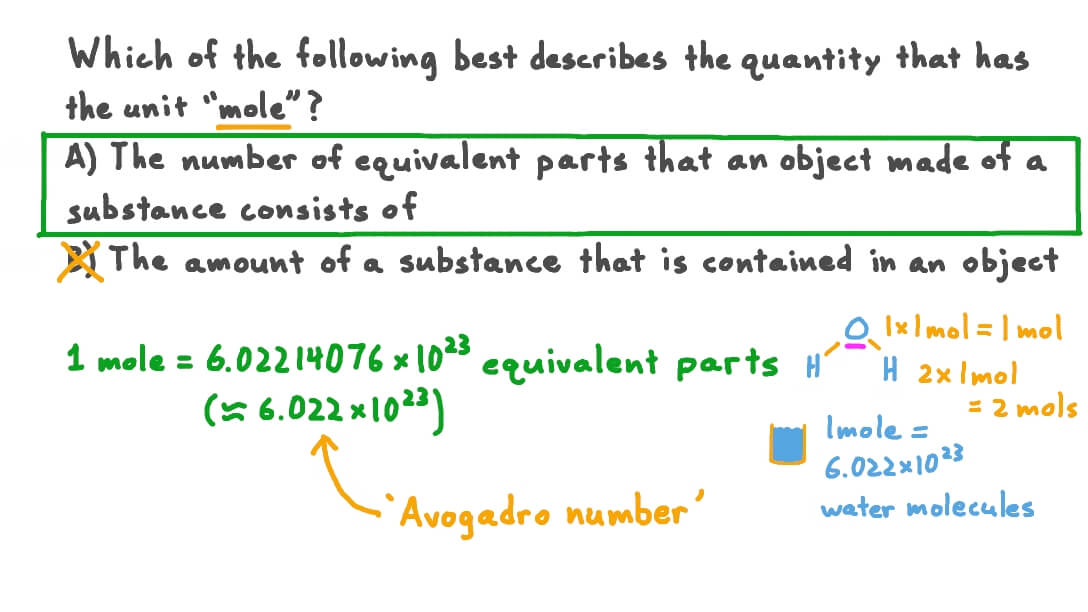
A mole is a way to count tiny particles like atoms or molecules. It equals 6. 022 x 10²³ of these particles, known as Avogadro’s number. This helps chemists measure substances easily.
What Is Avogadro’s Number?
Avogadro’s number is a constant used in chemistry. It tells us how many particles are in one mole of a substance. The value is 6.022 x 10²³. This number is huge. It helps scientists count atoms, molecules, or ions without counting each one.
Why Is Avogadro’s Number Important?
It connects the tiny world of atoms to the real world. One mole of any substance has exactly 6.022 x 10²³ particles. This makes measuring easier. Chemists can weigh substances and know how many particles they have. It helps in reactions and calculations.
How Was Avogadro’s Number Determined?
Scientists found this number by experiments. They measured gas volumes and used light to count particles indirectly. It took many years to get the exact value. Today, this number is a key part of chemistry and physics.
Credit: www.nagwa.com
Mole In Chemical Calculations
The mole is a key unit in chemistry. It helps measure very small particles like atoms and molecules. Using the mole makes chemical calculations easier and more accurate.
Chemists use the mole to count particles without counting each one. This method simplifies working with large numbers. The mole links the mass of a substance to the number of particles it contains.
What Is A Mole In Chemistry?
A mole equals 6.022 x 10²³ particles. These particles can be atoms, molecules, or ions. This number is called Avogadro’s number. It is a fixed constant used worldwide.
Using Moles To Calculate Mass
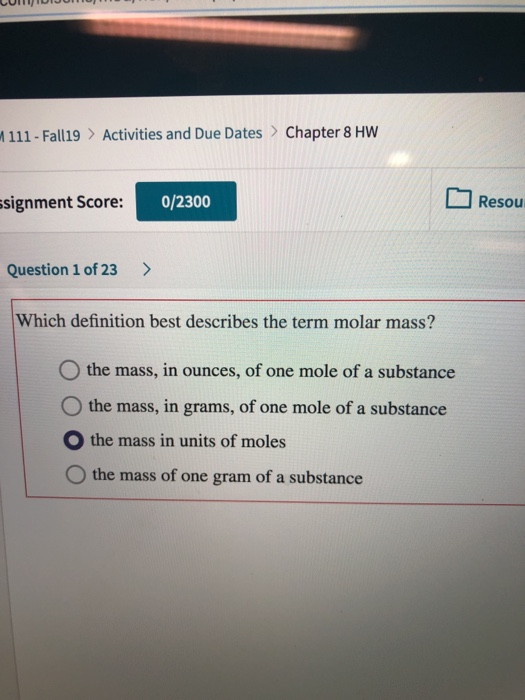
The mole helps convert between mass and number of particles. You can find the mass of one mole using the periodic table. This mass is called the molar mass and is measured in grams per mole.
Moles And Number Of Particles
Knowing the moles lets you find the number of particles. Multiply the moles by Avogadro’s number. This calculation shows how many atoms or molecules are present.
Mole In Chemical Reactions
Chemical equations use moles to show reactants and products. Moles help balance these equations correctly. They ensure the right amount of substances react together.
Common Misconceptions About Moles
Moles often confuse many people. People hear the word “mole” and think of different things. Some think about animals, others about skin spots. In science, a mole means something else. This causes many wrong ideas.
Understanding what a mole really is helps clear up confusion. It also makes learning science easier. Let’s look at some common wrong ideas about moles.
What Is A Mole In Science?
A mole is a unit to count very small things. It counts atoms, molecules, or particles. One mole always has the same number of these things. That number is very big: about 602,000,000,000,000,000,000,000.
Myth: A Mole Is A Small Animal
Many think a mole is a tiny animal. That is true outside science. But in chemistry, a mole is not an animal. It is a way to count tiny particles.
Myth: A Mole Is A Weight Or Volume
Some believe a mole means weight or space. Actually, a mole counts particles, not weight. Weight and volume depend on the substance’s type and amount. A mole is about the number, not size or weight.
Myth: All Moles Are Equal In Size
People think one mole of everything looks the same. This is not true. One mole of feathers takes more space than one mole of iron. The number is the same, but size and weight differ.
Real-world Applications Of The Mole
The mole is a key concept in chemistry that helps us count tiny particles. It connects the microscopic world to the amount we can measure. Scientists and students use the mole to understand reactions and materials better.
Many real-life fields rely on the mole to solve problems and create new things. It helps in labs, industries, and even in daily products. Knowing how the mole works gives clear answers in chemistry and science.
Measuring Chemicals In Laboratories
Chemists use the mole to measure exact amounts of substances. It ensures reactions happen correctly and safely. Without the mole, mixing chemicals would be guesswork and risky.
Pharmaceutical Industry
Drug makers count molecules using the mole. This ensures medicines have the right strength. Accurate doses help medicines work well and stay safe for patients.
Food Industry
The mole helps in food production by measuring ingredients at the molecular level. It controls quality and taste. Producers keep food safe and consistent using this method.
Environmental Science
Scientists track pollutants by calculating moles of harmful chemicals. This helps monitor pollution and protect nature. They can plan ways to clean air and water effectively.
Material Science
Experts use the mole to study materials like metals and plastics. It helps create new, better materials. This knowledge leads to stronger and lighter products.
Frequently Asked Questions
What Is A Mole In Chemistry?
A mole is a unit that counts particles like atoms or molecules. It equals 6. 022 x 10²³ particles, known as Avogadro’s number.
Why Is Avogadro’s Number Important For A Mole?
Avogadro’s number defines how many particles make one mole. It links the microscopic scale to the amount we can measure.
How Does A Mole Relate To Mass And Atoms?
One mole of a substance has a mass in grams equal to its atomic or molecular weight. This helps convert between mass and number of particles.
Can A Mole Describe Different Substances Equally?
Yes, a mole counts particles regardless of type. One mole of any substance contains the same number of particles.
Conclusion
A mole is a basic unit in chemistry. It helps count tiny particles like atoms and molecules. One mole equals 6. 022 x 10²³ of these particles. This number is called Avogadro’s number. Understanding moles makes chemistry easier to learn and use.
It links the small world of atoms to the larger world we see. Knowing what a mole means helps in many science topics. Keep this idea in mind for future chemistry studies. Simple but powerful.