When the James Webb Space Telescope (JWST) launched on Christmas Day 2021, scientists hoped it would reveal the first galaxies, peer into planetary atmospheres, and show star birth in new detail. It has done all of that and more. Many of its biggest James Webb discoveries were things nobody expected to find. This guide walks through 12 of them in simple language, with no physics degree needed.
Thank you for reading this post, don't forget to subscribe!A Quick Look at Webb Before the Discoveries
Webb is a joint mission of NASA, the European Space Agency (ESA) and the Canadian Space Agency (CSA). According to NASA’s official Webb page, it does not orbit Earth the way Hubble does. Instead it orbits the Sun about 1.5 million kilometers (1 million miles) from Earth at a spot called the second Lagrange point, or L2. A five-layer sunshield protects its instruments from the heat of the Sun, Earth and Moon.
Webb sees the universe in infrared light, which we feel as heat but cannot see. That matters because the light from the earliest galaxies has been stretched by the expanding universe into infrared wavelengths. A telescope built for infrared can therefore look much further back in time than one built for visible light.
Discoveries From the Early Universe
1. A Deep Field Packed With Ancient Galaxies
One of Webb’s first images, released in July 2022, showed the galaxy cluster SMACS 0723 as it looked about 4.6 billion years ago. The cluster’s gravity acts like a lens and magnifies even more distant galaxies behind it. Tiny smudges in that picture were whole galaxies, each holding billions of stars. It was an early sign of how sensitive Webb really is.
2. The Most Distant Galaxy Ever Confirmed
Webb keeps breaking its own distance record. NASA reported in January 2026 that a galaxy named MoM-z14 existed only 280 million years after the Big Bang, with a redshift of 14.44. It beat the earlier record holder, JADES-GS-z14-0, which sits at about 300 million years after the Big Bang. You can read the details in the STScI news release. Redshift is simply a measure of how much the light has been stretched on its way to us, and a bigger number means a more distant, older view.
3. Early Galaxies That Are Far Too Bright
Before Webb, theories predicted only a few well-developed galaxies in the first few hundred million years. The research team behind MoM-z14 says it belongs to a growing group of surprisingly bright galaxies, roughly 100 times more numerous than pre-launch models predicted. MoM-z14 is also brighter, more compact and richer in heavy elements than expected. Astronomers are still working out how stars and galaxies could form so quickly.
4. The Mystery of the Little Red Dots
Webb’s deep surveys turned up many compact, very red objects nicknamed little red dots. They appear when the universe was only a few hundred million to about a billion years old and then seem to fade from view. A 2026 study led by researchers at the Cosmic Dawn Center in Copenhagen proposes that they are young supermassive black holes wrapped in dense, glowing gas cocoons. The heat shining through that cocoon would explain the red color. The debate is not fully settled, which is exactly why little red dots remain one of the hottest topics in astronomy.
5. Heavy Metals Around Our Own Black Hole
Webb also looks closer to home. Our earlier coverage explains how Webb detected heavy metals around the black hole at the center of the Milky Way, a finding that deepened an existing mystery about this local giant.
Discoveries About Planets and Moons
6. Carbon Dioxide on a Planet Beyond Our Solar System
In 2022, Webb captured the first clear evidence of carbon dioxide in the atmosphere of an exoplanet, a hot gas giant called WASP-39 b. The planet is about 700 light-years away and circles its star in just over four Earth days. As the planet crossed in front of its star, starlight filtered through its atmosphere, and the pattern of missing colors revealed the gases inside. NASA’s earlier report on this result calls it a hat trick of firsts, and it showed that Webb can read exoplanet atmospheres in remarkable detail.
7. Methane and Carbon Dioxide on K2-18 b
Webb has also studied K2-18 b, a sub-Neptune about 124 light-years away, and found carbon-based molecules in its atmosphere. Some data hinted at a gas called dimethyl sulfide, which on Earth is produced almost entirely by living things. That hint is only a possible signal and is disputed, so it should not be read as proof of life. It does show how Webb is moving the search for habitable worlds from guesswork toward real measurements.
8. A 6,000-Mile Water Plume on Enceladus
Saturn’s small icy moon Enceladus is only about 313 miles across, yet Webb detected a water vapor plume stretching more than 6,000 miles, over 20 times the size of the moon. NASA’s Goddard team reported that the vapor gushes out at about 79 gallons per second and feeds a donut-shaped cloud around Saturn. A salty ocean lies beneath the moon’s icy crust, which makes Enceladus a prime target in the search for life beyond Earth.
9. Neptune’s Rings in Their Clearest View in Decades
In 2022, Webb released the clearest look at Neptune and its rings in decades. Faint dust bands between the brighter, ice-dominated rings appeared as fuzzy particles. Because methane gas in Neptune’s atmosphere absorbs infrared light, the planet itself looks dark in Webb’s image while the rings glow.
Discoveries About Stars and Cosmic Events
10. Star Nurseries Seen Through Cosmic Dust
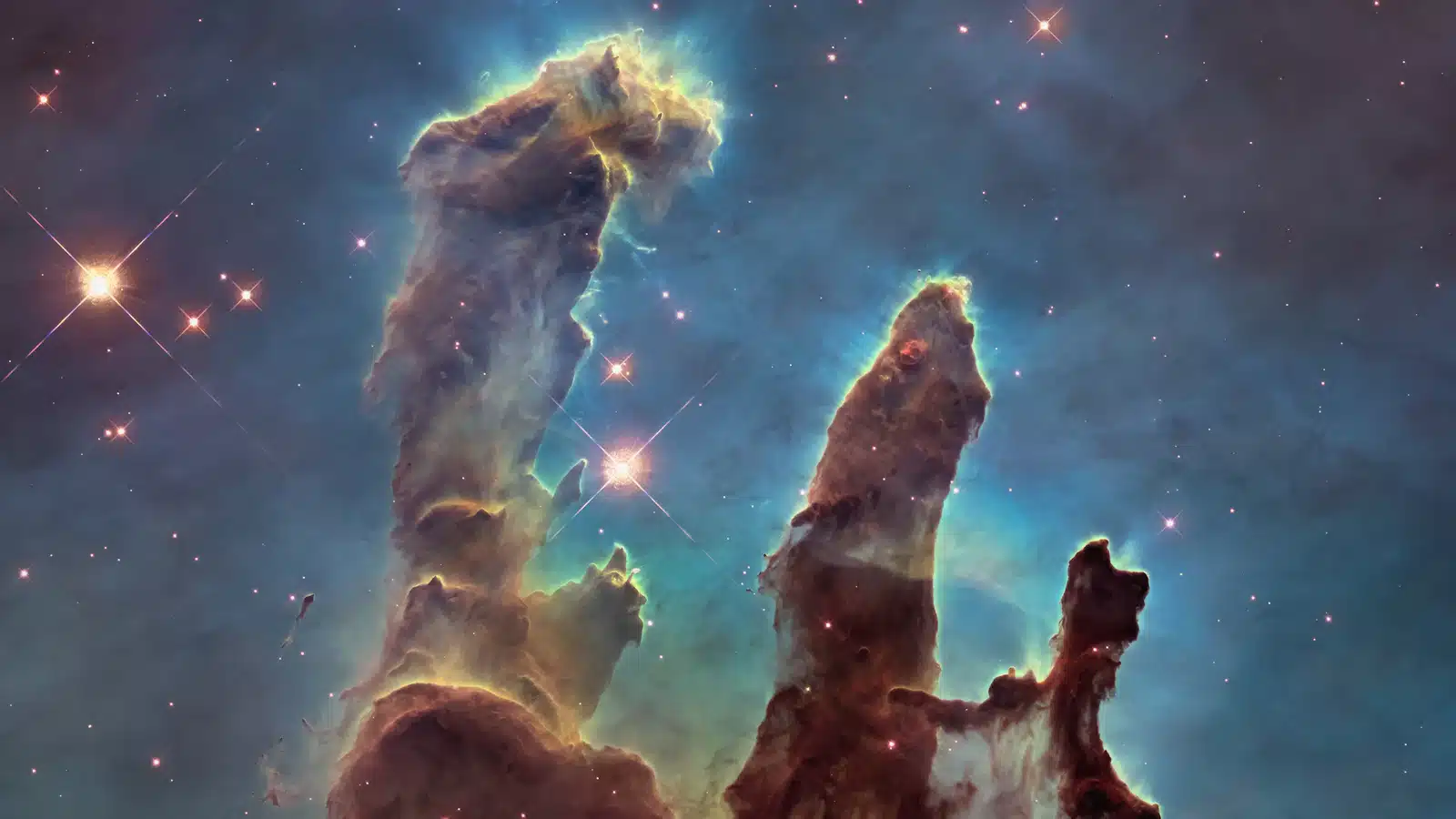
Dust blocks visible light, but infrared passes through it. Webb’s images of places like the Carina Nebula and the Pillars of Creation reveal newborn stars hidden inside thick clouds. Webb keeps adding to this gallery, including a large new view of the star-forming region IC 348 that NASA shared in September 2026. For more of the telescope’s giant pictures, see our post on one of Webb’s biggest images ever.
11. The Farthest Fast Radio Burst
Fast radio bursts are millisecond-long flashes of radio waves from deep space, first discovered in 2007. Their origins are still debated. In October 2026, NASA announced that Webb measured the distance to the farthest fast radio burst yet, which offers fresh clues about where such bursts come from. We covered an earlier record in our article on the most distant fast radio burst pinpointed by Webb.
12. A Star That Swallowed Its Companion
In November 2026, NASA highlighted a first-of-its-kind result. Researchers pieced together a stellar merger in the Andromeda galaxy, in a binary system nicknamed Bao, where a star slightly less massive than the Sun spiraled into and merged with its partner. Webb observations from December 2025 supplied the final evidence, as described in NASA’s feature story. It is a rare chance to watch what happens before, during and after two stars collide.
Why These Discoveries Matter
Taken together, these findings show a pattern. The early universe was busier, brighter and more chemically rich than theory predicted. Planets can be studied atmosphere by atmosphere. Even familiar objects, from Neptune’s rings to nearby star nurseries, look new in infrared. Each answer raises new questions, which is how science moves forward.
What Comes Next
Webb is far from finished. Mission teams report that careful launch and orbit maneuvers saved fuel, which could allow around two decades of operations. NASA’s newer Nancy Grace Roman Space Telescope will survey huge areas of sky, as we explained in our article on the first test image from the Roman telescope. Concepts such as the PRIMA telescope may someday look even deeper into the infrared universe, as covered in our PRIMA report.
Frequently Asked Questions
What is the James Webb Space Telescope?
It is the largest and most powerful space telescope NASA has launched, built with ESA and CSA. It observes infrared light from a point about 1.5 million kilometers from Earth.
What is the most distant galaxy Webb has found?
As of NASA’s January 2026 announcement, it is MoM-z14, seen as it was 280 million years after the Big Bang. NASA expects the record to be broken again as observations improve.
Why does Webb use infrared instead of visible light?
Light from very distant galaxies is stretched into infrared by the expanding universe, and infrared also passes through dust that hides stars and planets in visible light.
Has Webb found signs of alien life?
No. Webb has found molecules in exoplanet atmospheres and one disputed hint on K2-18 b, but nothing that scientists accept as evidence of life.
Summary
From a galaxy that existed just 280 million years after the Big Bang to a 6,000-mile water plume on Enceladus and a merging pair of stars in Andromeda, the James Webb Space Telescope keeps rewriting what we know about the cosmos. Its most surprising results, like the little red dots and the overly bright early galaxies, show that the universe still has plenty of secrets. Follow the official NASA Webb mission page for new releases, and check back here for more space explainers.
Note: This article is for general education. Scientific findings are updated often, so check NASA, ESA and STScI releases for the latest results.