For most of the space age, a rocket was a one-way ticket. Engineers spent years building a machine worth hundreds of millions of dollars, burned it for a few minutes, and let the pieces fall into the ocean. Then, on December 21, 2015, a Falcon 9 first stage came back from the edge of space and settled onto a pad at Cape Canaveral, standing upright on its own legs. Understanding reusable rockets physics explains why that moment changed the economics of spaceflight, and why landing a rocket is so much harder than launching one.
Thank you for reading this post, don't forget to subscribe!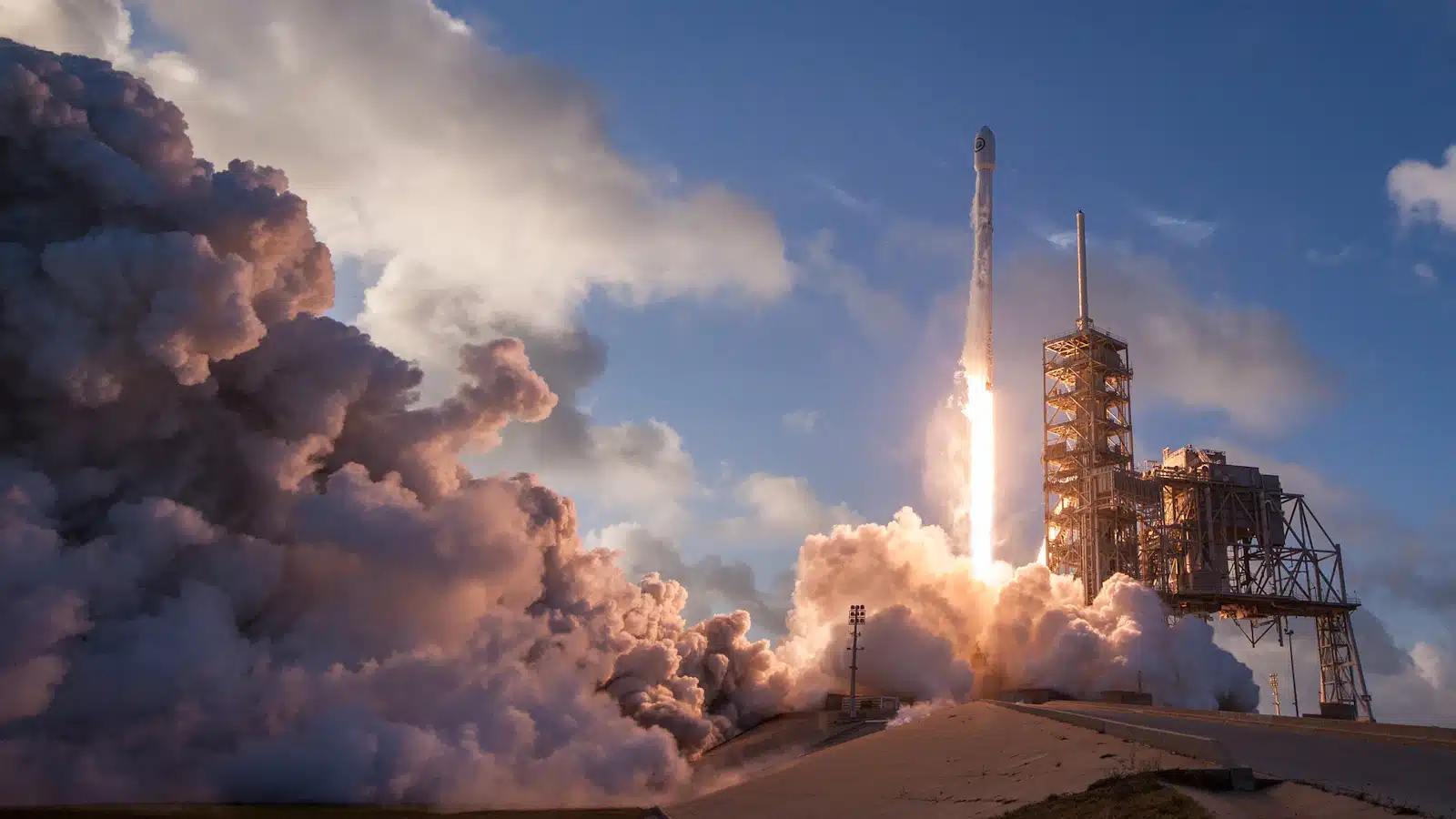
In this guide we walk through the whole journey of a returning booster: the burns, the aerodynamic steering, the control loops, and the physics that make a controlled vertical landing possible. We use the Falcon 9 as the main example because it is the best documented, and we also touch on how the idea is evolving with Starship.
Why Landing a Rocket Is Such a Hard Problem
A rocket is built to go up. Most of its mass at liftoff is propellant, and the vehicle is designed around a single job: push a payload to speed. By the time the first stage has done its work, it is a tall, thin, nearly empty tube that is moving fast and still high above the ground.
Landing it means solving several problems at once:
- It is unstable. A tall empty booster behaves like a balancing broom. Any small error grows unless the controls keep correcting it.
- The engines cannot throttle very low. A rocket engine sized to lift a full vehicle is far too powerful for a nearly empty booster, so a landing has to be timed almost perfectly.
- The air is brutal. The booster re-enters the atmosphere at high speed and has to survive heating and pressure while still steering.
- There is one chance. Unlike an aircraft, a booster cannot circle around and try again once it has committed to a landing burn.
The Landing Sequence, Step by Step
According to SpaceX’s own Falcon 9 page, the first stage carries nine Merlin engines and is designed to fly back and land so it can be flown again. The sequence below is the commonly described order of events, drawn from SpaceX material and technical write-ups.
1. Stage separation
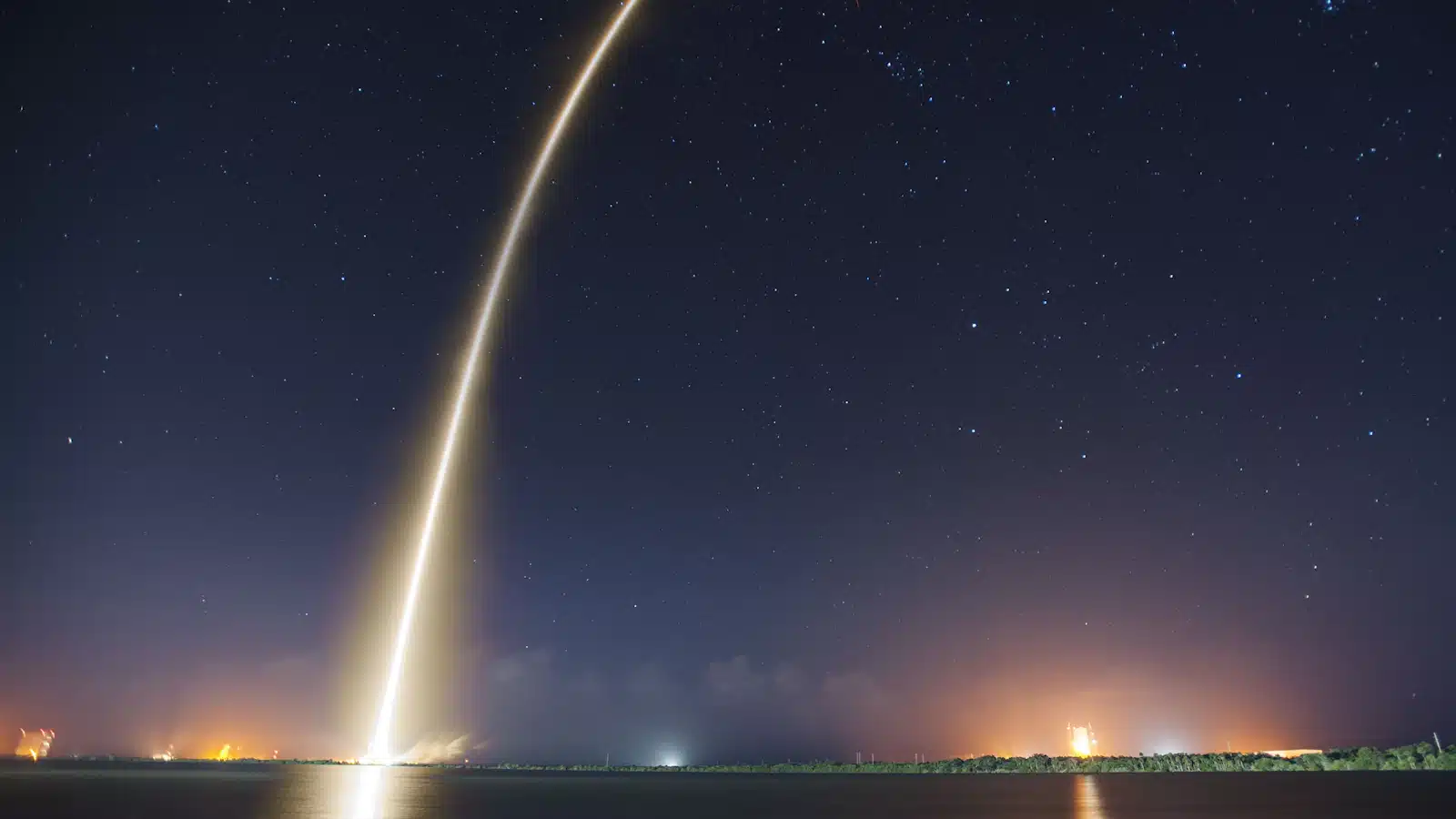
The nine Merlin engines burn for roughly two and a half minutes. Then the first stage shuts down and separates from the second stage, which carries on toward orbit with the payload. The booster does not fall immediately. It keeps coasting upward for a while, slowly losing speed as gravity pulls at it.
2. The flip
Small cold-gas nitrogen thrusters near the top of the booster fire to rotate it around, so its engines point along the direction it needs to push. In space there is no air to steer against, so these thrusters are the only way to point the vehicle.
3. The boostback burn
For missions that return to a pad near the launch site, a few engines relight for the boostback burn. A rocket launching eastward carries a lot of sideways speed, and this burn cancels it and sends the booster back toward land. On missions that land on a drone ship far out at sea, the boostback is skipped or shortened, because the booster is already travelling toward the ship.
4. Grid fins deploy and the entry burn
As the booster falls back toward the atmosphere, four grid fins fold out from the top of the vehicle. Shortly before it hits thicker air, the engines fire again in an entry burn that slows the booster and shields it from the worst of the heating. This is a supersonic retropropulsion burn: the engines fire forward into the oncoming airflow while the vehicle is still moving faster than sound.
5. The landing burn and touchdown
In the final seconds, the landing legs unfold and the engines ignite one last time. Descriptions of the Falcon 9 landing burn commonly mention a one-three-one engine sequence, which saves fuel. The burn is timed so that the booster’s speed reaches nearly zero just as it reaches the ground. Do it a moment too early and the booster would hover, run out of fuel and fall; a moment too late and it hits the deck at full speed. This idea of getting velocity to zero exactly at altitude zero is often called a hoverslam.
The Physics: Energy, Drag and the Rocket Equation in Reverse
Three bits of physics do most of the work in a landing.
Fuel is the price of coming home
Every burn that slows the booster uses propellant that could otherwise have carried more payload to orbit. The rocket equation, which links change in velocity to exhaust speed and the ratio of full to empty mass, applies just as much going down as going up. This is why reuse has a cost: heavier payloads or higher orbits leave less spare fuel, which is why those missions usually land on a drone ship or are expended. Light missions can afford to fly back to the launch site.
The atmosphere does free work
The booster does not have to cancel all its speed with engines. As it falls into thicker air, aerodynamic drag removes a large share of its energy for free. Engineers use the entry burn only to limit heating and to bring the vehicle to a speed the landing burn can handle. Clever trajectory design is, in effect, about letting the atmosphere do as much braking as possible.
Why the vehicle wants to tumble
In a stable aircraft, the aerodynamic center sits behind the center of mass, so the airflow naturally straightens the vehicle out. A falling booster with a heavy engine section has its mass concentrated at the bottom, which works in its favor, but it still needs help. Grid fins move the aerodynamic center of pressure higher up the vehicle, which increases stability and gives the controller levers to steer with. If you enjoy this kind of reasoning about shapes and stability, our explainer on the Klein bottle shows how geometry can surprise us in other ways.
The Control Systems That Steer a Falling Rocket
A returning booster is steered by three different systems, each effective in a different part of the flight.
- Cold-gas thrusters do the job in the thin upper atmosphere and in space, where there is no air for fins to push against.
- Grid fins take over as the air thickens. They are waffle-shaped aerodynamic surfaces that fold flat during launch to cut drag and open up for the descent. Early Falcon 9 flights used aluminum fins, which partly melted during re-entry, and SpaceX later moved to titanium fins that can be reused. Grid fins were not a SpaceX invention: the Soviet Union used them on its Soyuz capsule escape system and on the N1 Moon rocket.
- Engine thrust vectoring is the final tool. By tilting the engine nozzle slightly, the booster redirects its thrust and steers during the landing burn.
Grid fins matter enough that a failure can end a landing. After a Falcon 9 booster missed its landing zone on the CRS-16 mission, analysis pointed to the hydraulic pump that moves the grid fins stalling. The mission itself, delivering cargo to the space station, still succeeded, but the booster landed in the water. It is a good reminder that the steering hardware is as critical as the engines.
The Software: Solving an Optimization Problem in Real Time
Hardware alone cannot land a rocket. The real secret is the guidance software. Onboard computers read position and speed from sensors many times a second and decide how to move the fins and gimbal the engines. The landing burn is a classic optimal control problem: find the path that reaches the target at zero velocity while using as little fuel as possible, and keep re-solving it as the real flight drifts from the plan.
Technical descriptions of this approach often refer to convex optimization, a family of mathematical methods that can find a good answer quickly enough to run on flight hardware. The key idea is that the computer does not follow a fixed script. It keeps recalculating, so wind, engine variations and sensor noise are handled automatically.
NASA, Blue Origin and the Wider Reuse Story
SpaceX is not alone in this field. Vertical landing was explored for decades in NASA research, and many of the guidance ideas are documented in the NASA Technical Reports Server. Blue Origin has also landed its suborbital New Shepard booster, and the industry now treats reuse as the main route to cheaper access to space. For a closer look at a real heavy-lift mission that relies on this approach, see our coverage of the Roman Space Telescope launch aboard a Falcon Heavy, and our explainer on what the James Webb Space Telescope has discovered shows what cheaper launches could eventually enable.
From Landing Legs to Catching Boosters
Starship takes the idea further. Its huge Super Heavy booster is designed to be caught by the launch tower’s arms instead of landing on legs, which removes the weight of the legs altogether. SpaceX engineers also found that the Super Heavy booster could descend well with three grid fins that are about half as large again as the earlier design. The guidance approach is the same as on the Falcon 9, but with tighter tolerances because the booster has to arrive at one exact point beside the tower.
Why Reuse Matters
The point of all this engineering is cost and cadence. Boosters that can be inspected, refurbished and flown again let a launch provider fly far more often. Reports note that individual Falcon 9 boosters have flown more than 30 times, and that SpaceX launched 134 Falcon 9 missions in 2024, up from 96 in 2023. That pace would be impossible if every mission needed a brand-new first stage. The US Federal Aviation Administration licenses and oversees these launch and landing operations in the United States.
Frequently Asked Questions
Why don’t rockets land with parachutes?
Parachutes are heavy, hard to aim, and leave the booster landing wherever the wind takes it, often in the sea where salt water damages the hardware. Powered landing is precise enough to touch down on a small pad or a ship, and it lets the booster be reused with far less refurbishment.
What are grid fins for?
Grid fins are steering surfaces that guide the booster through the atmosphere on its way down. They fold flat during launch and open once the booster is falling back, giving the flight computer a way to steer and stabilize the vehicle.
Does every booster get recovered?
No. When a mission needs all the fuel for a heavy payload or high orbit, the booster may be expended. Others land on a drone ship at sea or return to a landing zone on shore, depending on how much fuel margin is left.
Why is landing harder than launching?
A launching rocket is heavy and its engines have plenty of authority. A returning booster is nearly empty, unstable, and travelling fast, and its engines are too powerful to hover. The landing must be timed to the second with no chance of a retry.
Summary
Vertical rocket landings look like magic, but they are the combined result of clear physics and careful engineering. A booster separates, flips with cold-gas thrusters, burns to turn back, steers with grid fins through the atmosphere, and fires a precisely timed landing burn while software keeps re-solving the best path. Every step trades fuel for reusability, and the payoff is a launch industry that can fly more often at lower cost. As Starship and other vehicles mature, the same physics is being pushed even further.
Note: This article is an educational overview based on public sources. Mission details, booster flight counts and launch totals change frequently, so check official sources such as SpaceX and NASA for the latest figures.