In the 1960s and ’70s, colorful comic book advertisements from the Transcience Corporation in New York City promised to mail anyone who sent cash, check, or money order a “bowlfull of happiness” — in reality, a small paper envelope of freeze-dried eggs. Dropped into salt water, the eggs would produce brine shrimp, also known as sea monkeys.
Brine shrimp are about a centimeter long and swim upside down, beating their legs madly and trailing their elongated abdomens behind them like tails. As scientists recently learned, these tiny swimmers can do more than just move themselves.
Researchers have long thought that in a turbulent system like a current of water, energy flows in only one direction, from larger scales to smaller ones, or vice versa, depending on the system’s dimensions. But in observing the humble brine shrimp, scientists at the University of Pittsburgh realized that — with just a tiny adjustment — the flow of energy could be reversed.
The scientists discovered that they could direct the cascade of energy in a two-dimensional system by disrupting the system’s flow with a small obstacle, as long as it was angled just right. “The geometry matters,” said Lei Fang, the Pittsburgh engineer who led the new study.
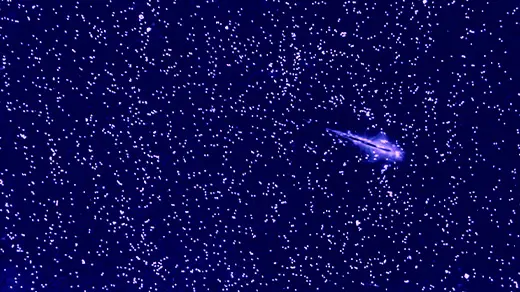
Brine shrimp are tiny invertebrates that inhabit waters with high salt concentration. They grow to about 10 millimeters long, the width of a pencil eraser.
Nature Picture Library/Alamy
The discovery capitalized on a fundamental, if often unrecognized, mathematical description of how forces interact to push energy through a system, said Gregory Falkovich, a physicist at the Weizmann Institute of Science and a pioneer in the study of turbulent two-dimensional systems. “This is a beautiful and skillful experimental work.”
These findings could extend to larger, more chaotic systems, including those in three dimensions. The work has implications for our understanding of fluid dynamics and may have applications in areas such as pollution control and drug design.
A Cascade of Chaos
Turbulence is hard to miss. It stirs the raucous foam at the base of a waterfall and shapes the crest of a breaking wave. It’s behind the bumpiness of a flight, the swirls of milk in a cup of coffee, and the roil of plasma on the surface of the sun. “We observe turbulence generally everywhere in our lives, when we go to the beach or wash our hands,” said Francesca De Serio, a civil engineer and expert on hydrodynamics at the Polytechnic University of Bari in Italy.
A turbulent system is complicated, characterized by complex forces and inner turmoil. But it can start simply enough. For example, turbulence arises when a flowing fluid encounters an obstacle that changes the velocity of part of the flow. In a river, water slows down by the bank due to friction, and the velocity mismatches can produce vortices or eddies. When a river divides to move around a rock, speeds change and voids form; water falls over itself and may start to rotate. Air, too, is a fluid, its turbulence produced by competing currents and changing temperatures.
In such a system, energy moves between size scales. English mathematician and physicist Lewis Fry Richardson, the founder of modern weather forecasting, discovered this when he studied the fluid systems formed by gases in the atmosphere. He found that the kinetic energy of a large eddy feeds into smaller and smaller eddies, until it reaches the scale where viscosity, which resists motion, takes over. The energy is ultimately dissipated as heat. In 1922, Richardson captured the concept in verse:
Big whorls have little whorls
Which feed on their velocity,
And little whorls have lesser whorls
And so on to viscosity.
Starting in the early 1940s, the Soviet mathematician Andrey Kolmogorov provided a clear and rigorous mathematical foundation for the study of turbulence. But his work, like Richardson’s, mainly focused on three-dimensional systems in which energy flows from large features to small ones.
In the late 1960s, the physicists Robert Kraichnan and George Batchelor extended the investigation to two-dimensional systems. Two-dimensional turbulent systems include phenomena like Jupiter’s Great Red Spot, which swirls so violently that it overwhelms any motion farther down in the atmosphere. This type of two-dimensional turbulent system transfers energy from one scale to another, like a three-dimensional one, but with a twist: The energy of a two-dimensional turbulent system cascades in the opposite direction, moving from small eddies up to large ones. In Jupiter’s Great Red Spot, smaller eddies and vortices near the perimeter feed the giant maelstrom in the center.
In the decades after those pioneering studies reported an inverse flux in two-dimensional systems, physicists did not deeply interrogate whether those flows were fixed. The underlying energy mechanisms of two-dimensional turbulent systems certainly weren’t on the mind of Xinyu Si around 2021, when he started investigating brine shrimp as a student in Fang’s lab.
Swimming in the Energy Flow
Fang’s lab focuses on “active matter,” a physics term describing things that move by themselves and inject energy into their environments. It’s a label broad enough to include networks of living things, like bacteria, and nonliving things, like tiny robots.
In this project, Si and Fang were interested in investigating how biological swimmers mix materials in fluids where turbulence shows up. The researchers had hypothesized that, in the mixing of fluids in large natural systems, turbulence generated by tiny organisms plays an underappreciated role. Billions of minuscule creatures, after all, agitate the waterways of the world.