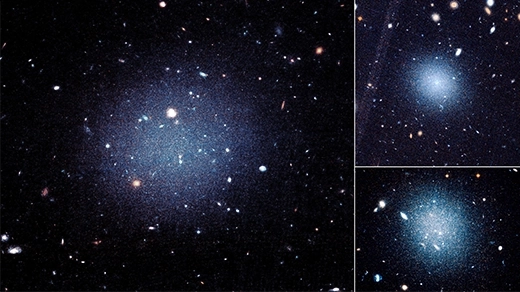
About 65 million light-years from Earth, three galaxies don’t look quite right. They aren’t whirlpools bursting with light, but pallid objects dimly illuminated by a smattering of stars. “They have this ghostly appearance,” said Michael Keim, an astrophysicist at Yale University. And this isn’t even the weirdest thing about them.
Dark matter is the invisible glue that keeps the largest structures in the cosmos together. It draws ordinary, visible matter toward it, allowing stars to form and keeping the stelliferous limbs of galaxies from flying off. “Almost all galaxies are dominated by dark matter,” said Shyam Balaji, a theoretical physicist at King’s College London.
But these three diffuse galaxies, known as DF2, DF4, and DF9, have left astronomers stunned. After using a suite of telescopes to estimate their masses — using the motions of their stars as a proxy — the researchers found that all three have little dark matter. Instead, a pittance of ordinary matter alone must have forged their small selection of stars. How could these rule-breaking galaxies have formed?
A paper published in June 2026 in The Astrophysical Journal offers a potential solution. Once upon a time, two regular galaxies collided. Their ordinary matter — their gas and dust — swirled about and got clumped up. But the dark matter passed right through and continued on, like a specter passing through a wall. The cosmic pileup left behind three new galaxies, each bereft of dark matter, each left to struggle to form a new batch of stars.
It’s a convincing explanation for many experts — one that, crucially, may tell us something about the mystery of dark matter.
Some scientists have suggested that dark matter, which has yet to be directly detected, may not exist. Instead, they propose that a tweak to our understanding of the gravitational force might explain various features of the universe.
These bizarre galaxies pour cold water on that idea. “What this is showing is that dark matter is … not just a modification of gravity,” said Keim, who is an author of the new study. If you segregate ordinary matter from dark matter, you’d expect that the dark matter–lacking galaxies would struggle to form stars — and that’s what DF2, DF4, and DF9 show.
That suggests, as many have suspected for some time, that dark matter is a physical thing. “The absence of dark matter is, in a way, some evidence of dark matter, which is ironic,” Balaji said.
Dark Ghosts
What, exactly, is dark matter? Ever since it was formally proposed by the astronomer Fritz Zwicky in the 1930s — and built upon in the 1970s by the astronomer Vera Rubin — cosmologists and astrophysicists have been putting forward their best candidates. Could it be a stealthy type of neutrino? Might it be so-called weakly interacting massive particles, or WIMPs? Some have even opined that it could be primordial black holes as small as individual atoms and as old as the universe itself.
“We don’t know which dark matter candidate is the right one,” said Daniel Whiteson, a particle physicist at the University of California, Irvine. Whatever it is, it has yet to be detected. But “there’s a lot of independent lines of evidence that dark matter is matter.”