For comparison, the solutions of $latex x^{3}\kern0.5pt-\kern0.5pt2 = 0$ modulo 13 are $latex \sqrt[3]{2}$, $latex 3\sqrt[3]{2}$, and $latex 9\sqrt[3]{2}$, which in this case all lie outside the number field defined by this prime. Now, raising each solution to the 13th power transforms it into one of the others. For example, $latex (\sqrt[3]{2})^{13} = \sqrt[3]{2}[(\sqrt[3]{2})^3]^4$ $latex = \sqrt[3]{2}(2)^4$ $latex = 16\sqrt[3]{2}$ $latex = 3\sqrt[3]{2}$ (modulo 13). That’s the 120-degree-rotation element of our Galois group S3, which has a trace of –1. Accordingly, the coefficient of $latex q^{13}$ in the modular form is –1.
The other coefficients of prime-exponent terms that define our modular form are determined by the symmetry properties of the solutions of $latex x^{3}\kern0.5pt-\kern0.5pt2 = 0$ modulo that prime; it leaves them unchanged if they are all in the number field, or switches the two that are not, or cycles all three solutions, providing the coefficients 2, zero, and –1, respectively. Somehow, Galois symmetries from the faraway galaxy of number theory paint the swirly pattern of this modular form. It’s not a simple connection, but it can’t be a coincidence.
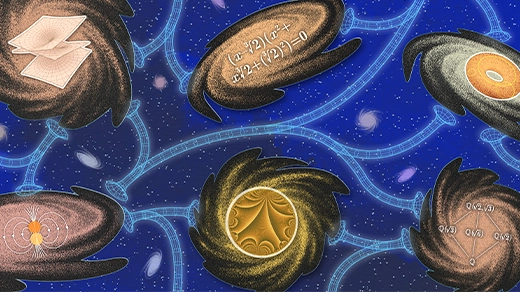
The correspondence I described here goes far, far beyond $latex x^{3}\kern0.5pt-\kern0.5pt2 = 0$ and $latex f(q)$. Langlands conjectured correspondences between all suitable Galois representations and automorphic forms (a generalization of a modular form). Although this sounds esoteric and isolated, it isn’t. Every mathematical object and idea logically relates to many others, so the discovery of a wormhole between distant parts of math, involving such fundamental objects as numbers, equations, groups, functions, and symmetries, has had widespread ramifications. Traversing the wormhole has often yielded proofs or insights about one side with the aid of the other.
In 1994, for example, the wormhole enabled the mathematician Andrew Wiles to prove Fermat’s Last Theorem, one of the most famous and long-standing open problems in math. You’ll recall that the Pythagorean theorem relates the three sides of a right triangle: $latex a^{2} +\kern0.5ptb^{2} = c^{2}$. Fermat guessed that for any whole number $latex n$ larger than 2, there are no three nonzero integers $latex a$, $latex b$, and $latex c$ that satisfy the equation $latex a^{n} + b^{n} = c^{n}$. No one could prove it for 357 years.
What finally worked was proving a Langlands-like correspondence. First the German mathematician Gerhard Frey showed that if Fermat’s Last Theorem is false, then you could use those numbers to write a formula $latex y^{2} = x(x\kern0.5pt-\kern0.5pta^{n})(x + b^{n})\ $defining a so-called elliptic curve. Other researchers then showed that such a curve could not possibly correspond to an infinite sum that’s modular, like our $latex f(q)$ above.
This meant Frey’s curve ran afoul of a Langlands-type correspondence called the Taniyama-Shimura-Weil conjecture, a precursor to Langlands’ 1967 idea that turned out to be a special case of the more general phenomenon he envisioned. The conjecture says that every elliptic curve over the rational numbers corresponds to a modular form. Wiles proved this conjecture true in a large enough class of cases to rule out the existence of Frey’s counterexample, thereby proving Fermat’s Last Theorem.
Analogues of the same wormhole have shown up in other areas of math.
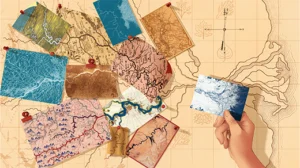
The person to whom Robert Langlands wrote his famous letter, the French mathematician André Weil, had sent a famous letter of his own in 1940, 27 years earlier, to his sister, the philosopher Simone Weil. In it, he had described a vision of a mathematical Rosetta stone with three columns. One column was number theory, another concerned curves over finite fields (a strange kind of geometry that takes place in the world of modular arithmetic), and the third involved the more familiar geometry of smooth surfaces. Weil observed patterns that were appearing in all three areas.
Indeed, each of Weil’s columns is now known to feature its own family of Langlands correspondences: wormholes linking one kind of mathematical object to another very different kind that somehow encodes the same information. In the number theory column, Galois representations connect to automorphic forms in the distant galaxy of harmonic analysis. For curves over finite fields, representations of their own Galois groups are likewise matched with automorphic forms. And for smoothly curving 2D spaces called Riemann surfaces, geometric objects describing symmetries and motions around the surface match more exotic objects of harmonic analysis called sheaves.
Decades of work and many of the field’s major prizes have gone toward proving conjectured Langlands correspondences in various settings. In 2024, for example, a group of mathematicians made headlines with a set of papers — more than 800 pages in total — that proved a major case of the geometric Langlands correspondence. Proving these correspondences also hastened progress in the connected research areas. “We can deduce things in one world using results in the other world,” said Jessica Fintzen, a mathematician at the University of Bonn.
We have to trust our mathematicians when they say there’s no apparent reason for the mysterious correspondences. “It’s the best possible world, but it’s very difficult to actually pinpoint what it means,” Fintzen said.
Ben-Zvi thinks of the Langlands program as a non-abelian version of Fourier analysis, which is one of the most ubiquitous tools in math and physics. As Joseph Fourier figured out in 1807, any signal — a sound wave, say, or a beam of light — can be decomposed into the pure tones or colors that make it up. Mathematically, these pure frequencies are sine waves, which, when shifted by regular intervals, don’t change. Picture sliding a sine wave left or right. If you shift it the right amount, it will appear not to have moved at all. The symmetries of sine waves are abelian; the order in which you shift the wave back and forth doesn’t matter. And in those waves, the coefficients that set the strength of each pure frequency are all simple numbers. Automorphic forms are like more sophisticated sine waves, and they can have non-abelian symmetries. In that case, the coefficients are tied to matrices and Galois representations — the original Langlands correspondence.
So perhaps the Langlands program sharpens a broader mystery of why Fourier decomposition is possible, why it lets us analyze signals, compress images, reconstruct medical scans, and do a million other things. That a complicated object can be broken down into a spectrum of pure components is something of an organizing principle of modern science.
Some of the researchers I spoke to suspect that objects on both sides of the Langlands correspondence might be shadows or facets of some other, still-hidden mathematical object or structure. “There is certainly some expectation that there could be something bigger that explains the kinds of relationships one sees in the Langlands program,” said Ana Caraiani, a mathematician at Imperial College London.
Supporting evidence for that view, and what seems to me to be one of the most important clues about the deep origins of the Langlands correspondence, came from thinking about the physical universe rather than the mathematical one. In the 2000s, the theoretical physicists Anton Kapustin and Edward Witten realized that the geometric Langlands correspondence is a consequence of a “duality” (a situation in which one system has two different physical descriptions) that’s exhibited by certain quantum theories. The simplest instance is the so-called electric-magnetic duality: When there are no charges or currents around, electric and magnetic fields are interchangeable; you could swap them and there would be no way to tell. (The presence of electrically charged particles such as electrons breaks the mirror between them, because no equivalent magnetic charges exist.)
Kapustin and Witten studied a model of space-time (the four-dimensional fabric of the universe) in which two spatial dimensions form a Riemann surface, the kind of 2D surface involved in the geometric Langlands correspondence. The physicists found that switching the electric and magnetic fields in this patch of space-time had the effect of switching between sides of the geometric Langlands correspondence.
That’s hard to parse, but according to Ben-Zvi, it showed that the two sides of geometric Langlands are conceptually close to each other in some way we don’t yet understand. Electric-magnetic duality reflects the fact that both fields are really aspects of a single, underlying quantum “electromagnetic field.” “It’s not two super-exotic worlds like Galois groups and automorphic forms, which sound totally unrelated,” he said, but rather a pair of intertwined quantum fields. Similarly, the various Langlands correspondences may eventually be understood as dual views of a single object or system.
Edward Frenkel, a mathematician at the University of California, Berkeley who has worked on the geometric Langlands program for decades, suspects so. “The real reason in my view is that there are things below the surface that have not yet been discovered,” he said.
On our video call, he held up a hot pink coffee cup, and we considered its shadows. “The projection onto the table will be a disk,” he said. “A projection on the wall will be a rectangle. And then you start marking and say, ‘Oh, there is a point here that connects to a point here.’ To you it appears surprising that points in one projection or shadow correspond to points in the other. But if you find the real source of this, if you start seeing the source and not just the projections, that would give you a much more convincing explanation of this duality or correspondence.
“Consciously or unconsciously,” Frenkel added, “people are excited about these connections precisely because they point to some deeper structures in mathematics that we have not found. Eventually we hope to find them, by finding more and more information which hopefully will lead us to the true explanation, the true reason.”